
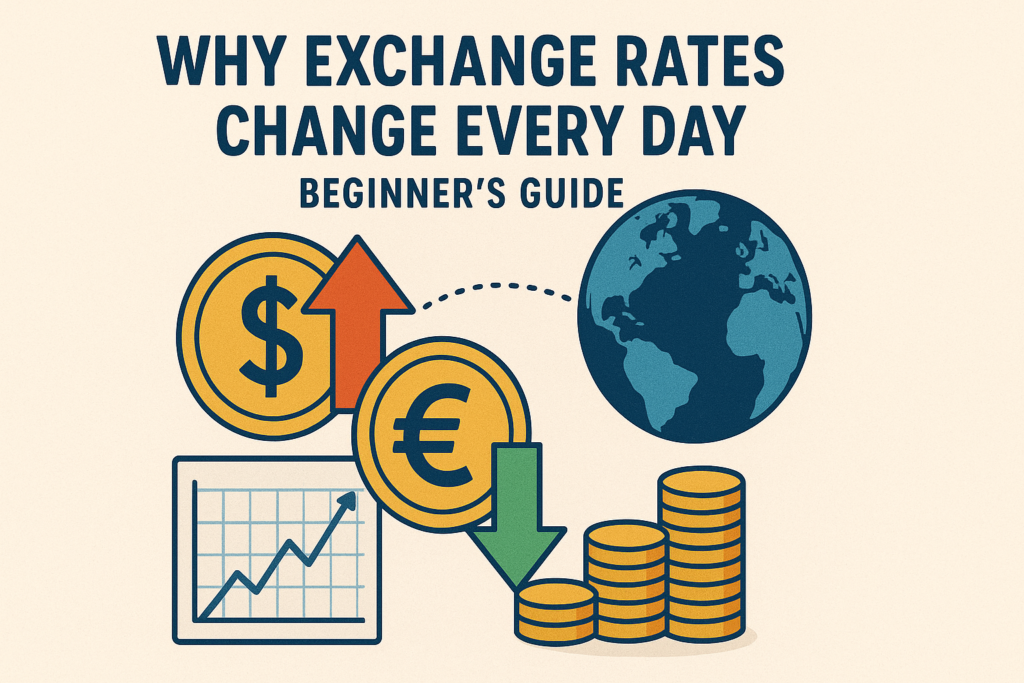
Have you noticed how exchange rates change all the time, even during the same day? For example, the rate between USD and HKD can go up or down without warning. If you’re confused, you’re not alone. This simple guide will help you understand why exchange rates move every day, so you can feel more confident about what’s happening in the currency market.
1. Exchange Rates Are Like Prices — They Rise and Fall
Think of currency like a product. Its value isn’t fixed—it constantly shifts in response to what buyers and sellers are doing in the financial marketplace.
Just like the price of gold, oil, or even vegetables in the market, the value of a currency changes based on:
• Supply (how much of that currency is available), and
• Demand (how many people or businesses want it).
If more people want US dollars today, the USD goes up. If fewer want it tomorrow, it goes down.
2. Interest Rates Influence Currency Value
Every country’s central bank sets interest rates (like the Federal Reserve, ECB, or HKMA).
Here’s the simple rule:
• Higher interest rates = stronger currency, Investors get better returns, so they buy more of that currency.
• Lower interest rates = weaker currency, Investors look elsewhere for better returns.
Example:
If the US increases interest rates, traders buy USD → USD becomes stronger.
3. Global News & Events Move Currencies
Markets react instantly to world events.
Some examples:
- Elections
- Natural Disasters
- War or Political tensions
- Economic announcements (GDP, Unemployment, Inflation)
Currency values can shift quickly due to news and global events. Positive developments, like economic growth or stable government, usually strengthen a country’s currency as investor confidence rises. Conversely, negative events—such as political instability, poor economic data, or disasters—can weaken a currency as investors pull out.
Example:
If inflation in Europe rises unexpectedly, the euro often falls.
4. Trading in the Foreign Exchange (FX) Market
The Foreign Exchange (FX) market stands as the largest financial market in the world, operating continuously throughout the week. Trading takes place 24 hours a day, from Monday to Friday, ensuring that participants can engage at any time, regardless of location.
This relentless activity is driven by millions of individuals, businesses, investment funds, and banks, all buying and selling currencies without pause. As a result, prices within the FX market are in constant flux. Exchange rates can shift from one minute to the next, reflecting the latest trades and market sentiments.
5. Supply & Demand From Trade and Tourism
Countries that export a lot (like Japan or Germany) usually experience strong demand for their currency.
This relentless activity is driven by millions of individuals, businesses, investment funds, and banks, all buying and selling currencies without pause. As a result, prices within the FX market are in constant flux. Exchange rates can shift from one minute to the next, reflecting the latest trades and market sentiments.
Examples of demand changes:
- Exporters receive payment in their home currency → demand goes up.
- Tourists buying foreign cash → demand goes up or down depending on season.
- Businesses buying goods overseas → demand shifts.
This natural flow of money changes rates daily.
6. Central Bank Interventions
Sometimes governments interfere to keep their currency stable.
They might:
- Buy their own currency in the market
- Sell foreign currency
- Adjust policies to control inflation or economic stability
When this happens, exchange rates move immediately.
Examples of demand changes:
The Hong Kong Dollar is linked to the US Dollar through the HKMA’s control mechanism — so HKD stays within a fixed band.
7. Market Sentiment (Trader Confidence)
This is emotional but powerful.
If traders feel optimistic:
- They buy more of a currency → it strengthens.
If they feel nervous:
- They sell → it weakens.
Market “mood” can shift suddenly.
These shifts in trader confidence ripple quickly through markets, sometimes causing sharp movements in exchange rates even when there’s no major economic news. That’s why, just like wholesale FX prices, the rates offered by your local money changer can vary throughout the day—reflecting not only underlying supply and demand but also the collective mood of the global marketplace.
8. Why Money Changer Rates Change Too
Your local money changer adjusts rates because:
- Wholesale FX prices change throughout the day
- Banks update their rates
- Demand for certain currencies increases (peak travel seasons)
- Limited supply of certain notes
So yes — the rate at 10 AM and the rate at 5 PM can be different.
8. Why Money Changer Rates Change Too
Your local money changer adjusts rates because:
- Wholesale FX prices change throughout the day
- Banks update their rates
- Demand for certain currencies increases (peak travel seasons)
- Limited supply of certain notes
So yes — the rate at 10 AM and the rate at 5 PM can be different.
9. Does This Affect You When Exchanging Money?
Your local money changer adjusts rates because:
- You might get a better deal on some days.
- Weekend or holiday movements can affect Monday rates.
- Booking your currency early can protect you from sudden changes.
This is why many travellers check the market a few days before exchanging.
Final Tip: How to Get a Better Rate
Here’s the simplest strategy:
- Monitor rates for a few days
- Exchange when the rate moves in your favour
- Use a trustworthy money changer with transparent rates
If you need HKD, other currency exchange rates or want the best deal, check out our currency exchange service at Hong Kong Forex Limited.
Citations
|
No.
|
Source
|
|---|---|
|
1
|
|
|
2
|
|
|
3
|
|
|
4
|
|
|
5
|
|
|
6
|
|
|
7
|